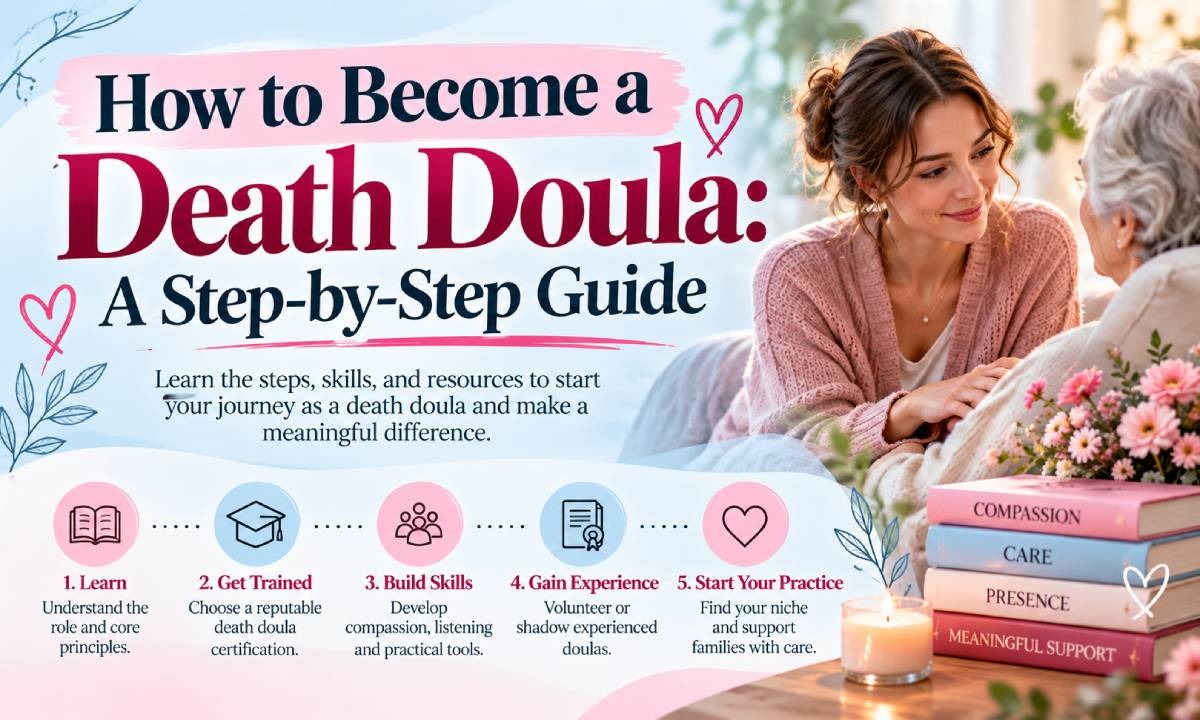
Many people feel called to sit with the dying and support their families. Maybe you lost someone and want to help others through the same road. Maybe you work in healthcare and want more time for personal care. Or maybe you simply want meaningful work. If that sounds like you, you may wonder where to start. The path is clear, and anyone with compassion can begin it.
A death doula is a non-medical guide who offers comfort, planning help, and steady presence. They support the dying person and their loved ones before, during, and after death. There is no single required route into the work. There is also no federal license in the United States. Most people follow a few simple steps: learn, gain experience, train, and begin.
This guide walks you through each step in plain words. You will see what a death doula does and who can become one. You will learn about certification programs, training costs, and key skills. You will also find out how much doulas earn and how to find training near you. Read it from start to finish or jump to the part you need.
What Is a Death Doula?
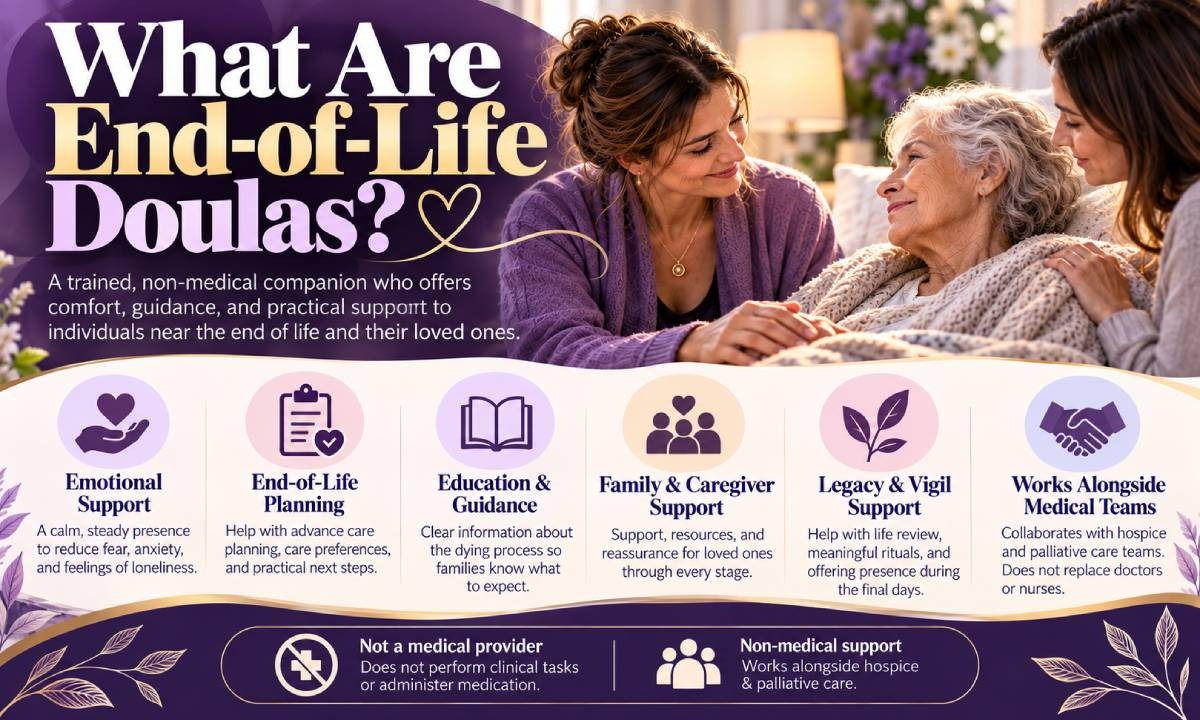
A death doula is a trained, non-medical companion for people at the end of life. They support the dying person and their loved ones through every stage. The role is also called an end-of-life doula. It is often compared to a birth doula, but at the other end of life. They never replace doctors or nurses. They simply add comfort, time, and steady presence.
- A death doula gives emotional, practical, and spiritual support. They do not give medical care.
- The role is also called an end-of-life doula. Both names mean the same kind of care.
- They work alongside hospice, nurses, and doctors. They never replace the medical team.
- They help people share wishes and plan ahead. These talks bring clarity and relief.
- They sit with families during the final days. Their calm presence helps everyone feel safe.
- They support loved ones after death too. Grief does not end when life does.
What Does a Death Doula Do?
A death doula’s work centers on presence, planning, and comfort. They listen, guide, and stay close when families feel lost. Every client is different, so the work is always personal. Some days it means a planning talk. Other days it means a quiet night at the bedside. The doula follows the wishes of the person and the family.
- They listen without judging or fixing. People can share fear, anger, and sadness safely.
- They guide planning conversations about wishes and comfort. Families avoid guessing in a crisis.
- They help create legacy projects like letters and recordings. These become lasting gifts.
- They plan the vigil and set a peaceful atmosphere. Music, light, and readings can all help.
- They give caregivers time to rest. This helps prevent burnout.
- They offer support after death. This can include rituals and early grief help.
Who Can Become a Death Doula?
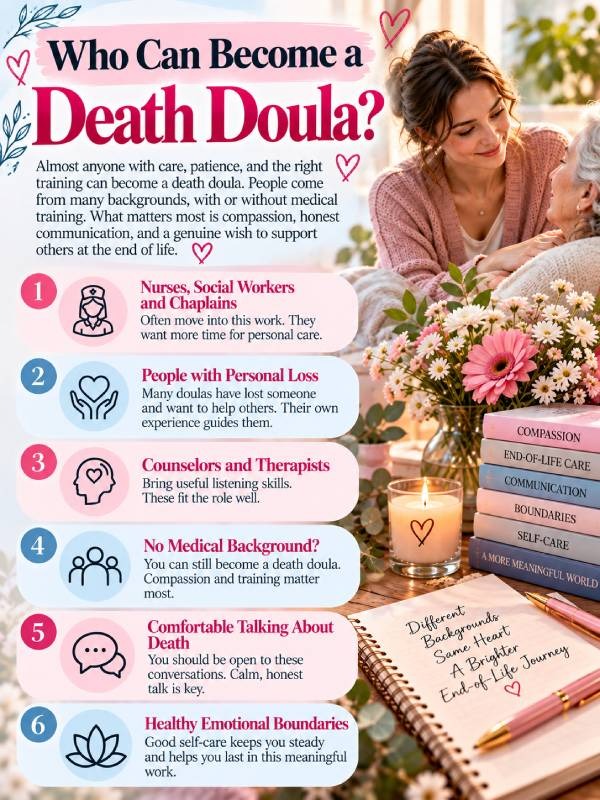
Almost anyone with care, patience, and the right training can become a death doula. People come from many backgrounds, including nursing, counseling, and chaplaincy. Others have no medical training at all. Many are drawn by a personal loss or a deep wish to help. What matters most is compassion and honest, calm communication. Healthy emotional boundaries also help you last in this work.
- Nurses, social workers, and chaplains often move into this work. They want more time for personal care.
- Many doulas have lost someone and want to help others. Their own experience guides them.
- Counselors and therapists bring useful listening skills. These fit the role well.
- People with no medical background can succeed too. Compassion and training matter most.
- You should be comfortable talking about death. Calm, honest conversation is key.
- You need healthy emotional boundaries. Good self-care keeps you steady.
Do You Need a License or Certification to Become a Death Doula?
There is no federal license for death doulas in the United States. The field is still young and mostly unregulated. Certification is usually optional, but it can build trust with families. Rules can also differ by state or country. This is why it helps to check local laws before you start. Good training will teach you your scope and your limits.
- No single license is required to practice. The field is largely unregulated.
- Certification is usually optional. It still builds trust with families and employers.
- Certification programs vary in length and depth. Compare them before you choose.
- Doulas must stay within a non-medical scope. They never give medical, legal, or financial advice.
- Some laws touch on body care and home funerals. Learn the rules where you work.
- A code of ethics and written agreements protect everyone. Ask any program how it handles them.
Steps to Become a Death Doula
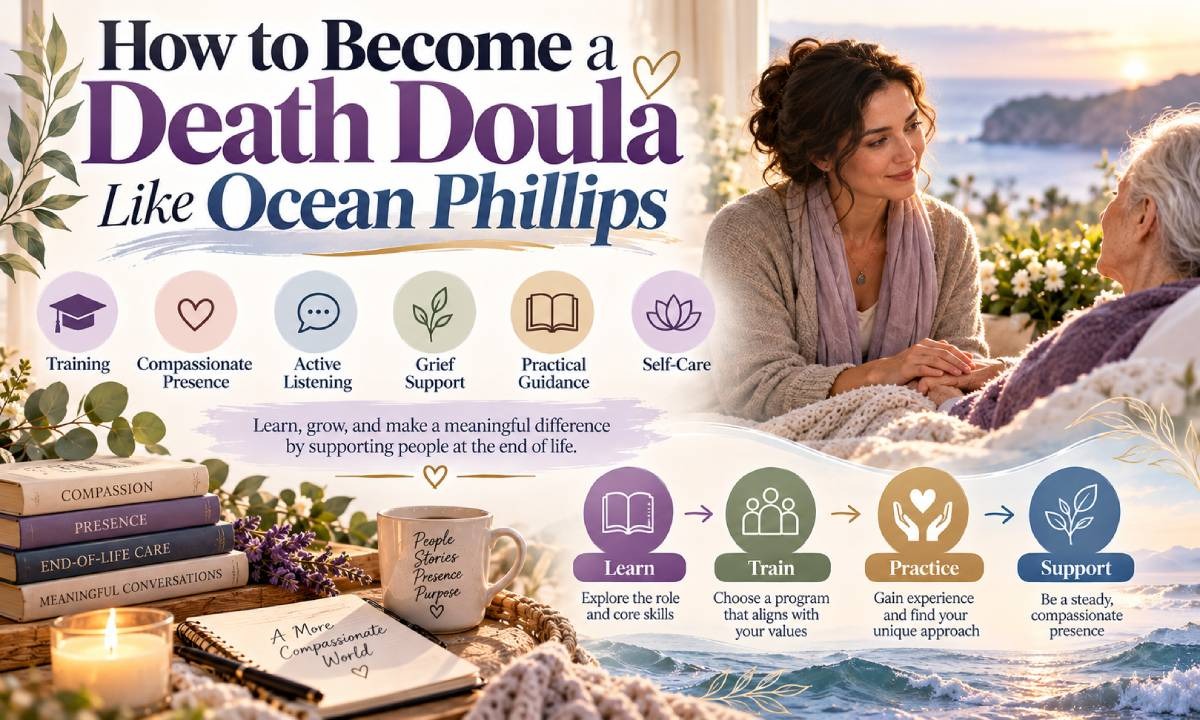
The path into this work is simple when you take it one step at a time. There are six main steps, from learning the basics to building your practice. You can move through them at your own pace. Some people finish in months, while others take longer. There is no single right speed. What matters is building real skill and confidence along the way.
- Step one is to learn about death and dying. Knowledge builds confidence.
- Step two is to gain hands-on experience. Hospice volunteering is a common way.
- Step three is to choose a certification program. Pick one that fits your goals and budget.
- Step four is to complete your training. Finish the coursework and any practice hours.
- Step five is to join a professional association. It connects you with peers and standards.
- Step six is to start practicing. Build your client base slowly and with care.
Educate Yourself About Death and Dying
Learning is the best place to begin. Before you spend money on training, build a basic understanding of death and grief. Reading and listening will show you if this work feels right for you. It also helps you face your own views about dying. Self-awareness is a key skill for any doula. The more honest you are with yourself, the better you can support others.
- Read books on end-of-life care and grief. Classics and modern titles both help.
- Learn about the physical and emotional stages of dying. This prepares you for real bedside moments.
- Attend a death cafe or community talk. These make the topic feel less scary.
- Listen to podcasts and talks by experienced doulas. You will hear real stories.
- Reflect on your own views about death. Self-awareness helps you support others.
- Learn about different cultures and beliefs around dying. Respect for all faiths is essential.
Volunteer or Gain Hands-On Hospice Experience
Books can teach a lot, but real experience teaches more. Time at the bedside shows you what dying actually looks like. It builds comfort, calm, and listening skills. Hospice volunteering is the most common way to start. Many hospices offer free training for volunteers. You also learn how medical teams work together.
- Contact local hospices about volunteer programs. Many offer free training.
- Visit people in care homes or hospitals. Simple companionship is valuable practice.
- Learn how hospice teams work together. This helps you fit into the care circle.
- Practice listening and staying calm in hard moments. These skills grow with time.
- Ask experienced doulas if you can shadow or be mentored. Learning from others speeds growth.
- Keep a private journal of what you learn. Reflection helps you grow and avoid burnout.
Choose a Death Doula Certification Program
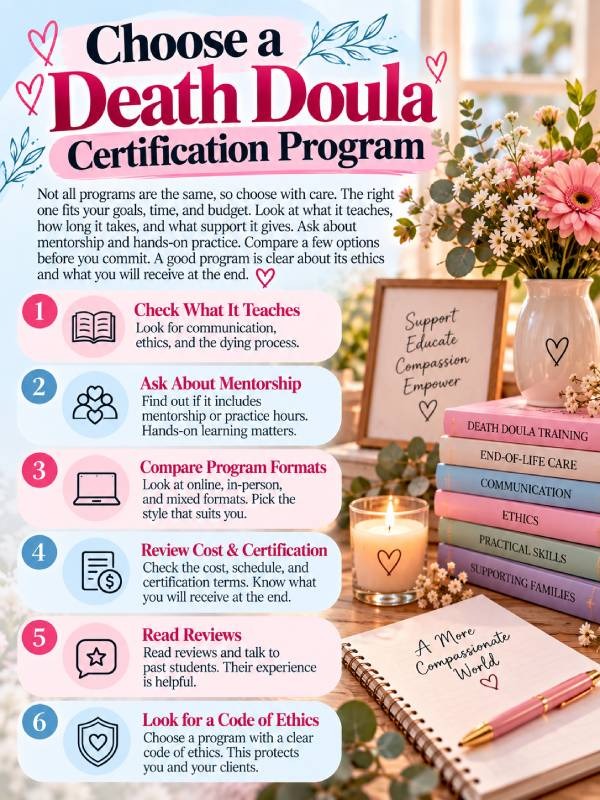
Not all programs are the same, so choose with care. The right one fits your goals, time, and budget. Look at what it teaches, how long it takes, and what support it gives. Ask about mentorship and hands-on practice. Compare a few options before you commit. A good program is clear about its ethics and what you will receive at the end.
- Check what the program teaches. Look for communication, ethics, and the dying process.
- Ask whether it includes mentorship or practice hours. Hands-on learning matters.
- Compare online, in-person, and mixed formats. Pick the style that suits you.
- Review cost, schedule, and certification terms. Know what you will receive at the end.
- Read reviews and talk to past students. Their experience is helpful.
- Look for a clear code of ethics. This protects you and your clients.
Complete Your Training
Once you enroll, commit to finishing the full course. Steady effort builds both skill and confidence. Attend each session and complete every assignment. Practice listening with classmates, even if it feels awkward at first. Ask questions whenever you feel unsure. Build self-care habits early, because caring for others takes energy.
- Attend all sessions and finish assignments. Steady effort pays off.
- Study the scope of practice carefully. Know what you do and do not do.
- Practice active listening with classmates. Role play can feel awkward but helps.
- Complete any required practicum or case work. Real-world learning is important.
- Ask questions when you feel unsure. Good teachers welcome them.
- Build self-care habits early. Supporting others is easier when you are well.
Join a Professional Death Doula Association
You do not have to do this work alone. Professional groups offer standards, community, and credibility. They share a code of ethics that guides your practice. Many also provide continuing education and peer support. Some have directories that help families find you. Joining a group can also help prevent burnout.
- Associations share a code of ethics. This guides your practice.
- Some offer credentialing paths. These help families trust your skills.
- You can meet and learn from experienced doulas. Mentors are often found here.
- Many provide continuing education. Skills stay fresh over time.
- Directories help families find you. This can bring new clients.
- A peer community helps prevent burnout. Shared stories make the work sustainable.
Start Practicing and Building Your Client Base
When training ends, begin gently and grow with care. Trust builds slowly in this field. Start with a few clients or volunteer cases and learn as you go. Set clear fees and write simple agreements. Share your story at community talks and connect with local hospices. Keep asking for feedback, because good doulas never stop learning.
- Start with a few clients or volunteer cases. Learn as you go.
- Set clear fees and write simple agreements. Clear terms protect both sides.
- Build a simple website or online profile. Families often search online first.
- Connect with hospices, hospitals, and care homes. Referrals can come from them.
- Share your story at community talks and death cafes. People remember honest voices.
- Ask for feedback and keep learning. Good doulas never stop growing.
Best Death Doula Certification Programs
Several well-known programs offer death doula training. Each one has its own style, length, and focus. The best choice depends on your goals and your budget. Some are mostly online, while others offer live sessions. Always compare a few before you decide. Check each program’s current details on its official website.
- INELDA is a widely known training and certification group. Many doulas start there.
- NEDA offers standards, ethics, and a credentialing path. It also has a directory.
- Doula Training International, or DTI, is another option to explore. Review its current course details.
- Some universities and hospices offer their own programs. Ask what is available near you.
- Compare length, cost, format, and mentorship. No single program fits everyone.
- Always confirm the latest details on each official website. Programs and fees can change.
INELDA (International End-of-Life Doula Association)
INELDA is a well-known group for doula education and certification. Many people choose it as their first step into the field. Its programs cover the core skills of the work, including communication and the dying process. It also has a growing community of doulas. Requirements, formats, and fees can change over time. Please confirm the latest details on the official site.
- It offers training programs for aspiring doulas. These cover the core skills of the work.
- Its courses focus on the dying process and communication. These are key for new doulas.
- Certification may require training and practice. Check the current requirements.
- The group has a growing community of doulas. Connection can support your journey.
- Formats may include online and in-person options. Confirm what is offered now.
- Always check fees and terms on the official site. Details can change.
NEDA (National End-of-Life Doula Alliance)
NEDA is a nonprofit alliance that supports end-of-life doulas. It focuses on standards, ethics, and professional community. It shares a code of ethics and a scope of practice. It also offers a credentialing path and a directory for families. Joining can help you connect with peers and be found by clients. Check the official site for current membership and credential steps.
- NEDA shares a code of ethics for doulas. This helps keep the work safe and professional.
- It outlines a scope of practice. This shows what doulas should and should not do.
- It offers a credentialing pathway. This builds family trust.
- It has a directory to help families find doulas. Joining may help you be found.
- It connects doulas with peers and resources. Community reduces isolation.
- Check the official site for current membership and credential steps. Details may change.
Doula Training International (DTI)
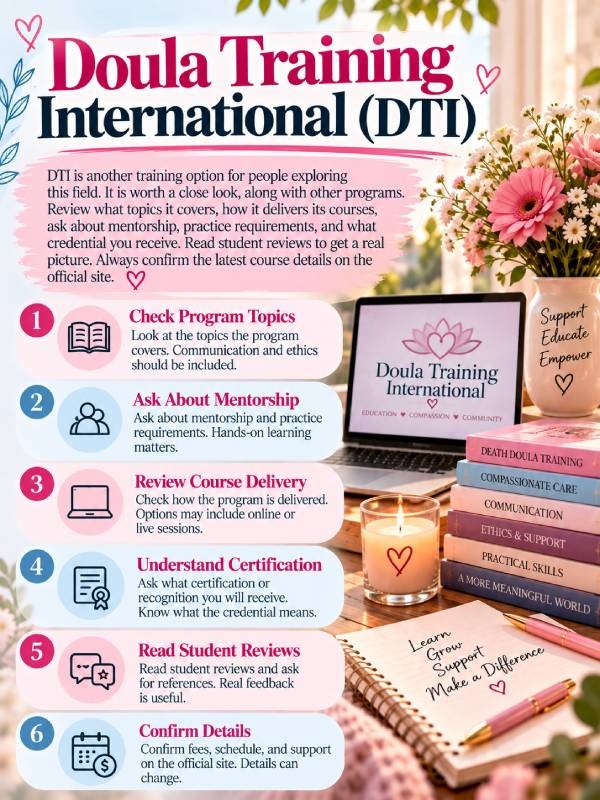
DTI is another training option for people exploring this field. It is worth a close look, along with other programs. Review what topics it covers and how it delivers its courses. Ask about mentorship, practice requirements, and what credential you receive. Read student reviews to get a real picture. Always confirm the latest course details on the official site.
- Look at the topics the program covers. Communication and ethics should be included.
- Ask about mentorship and practice requirements. Hands-on learning matters.
- Check how the program is delivered. Options may include online or live sessions.
- Ask what certification or recognition you will receive. Know what the credential means.
- Read student reviews and ask for references. Real feedback is useful.
- Confirm fees, schedule, and support on the official site. Details can change.
How Much Does Death Doula Training Cost?
Training costs vary a lot from one program to another. Short workshops cost less, while full certification courses cost more. Some options, like hospice volunteer training, may be free. Extra costs can include books, exam fees, and membership dues. Many programs offer payment plans, so it is worth asking. Compare the full value, not just the price.
- Free or low-cost options exist, such as hospice volunteer training. They are a good first step.
- Short workshops and webinars are usually more affordable. They suit beginners.
- Full certification programs often cost several hundred to a few thousand dollars. Prices differ by provider.
- Extra costs may include books, exam fees, and membership dues. Ask about these up front.
- Some programs offer payment plans. Always ask before you enroll.
- Compare value, not just price. Mentorship and support are worth considering.
Skills You Need to Become a Death Doula
People skills matter most in this work. The good news is that many of them can be learned and grown. Deep listening and a calm presence are at the top of the list. You also need clear communication and respect for all beliefs. Firm boundaries keep care safe for everyone. Self-care keeps you steady over the long run.
- Deep listening is the core skill. It makes people feel heard.
- Calm presence helps in emotional moments. Others will lean on your steadiness.
- Clear, gentle communication builds trust. You explain hard things in simple words.
- Respect for all beliefs and cultures is vital. No one should feel judged.
- Firm boundaries keep care safe. You know your scope and when to refer.
- Self-care and resilience protect you. Healthy doulas give better care.
📖 Read More
Learn more about this topic by visiting How to Become a Death Doula ↗ .
How Much Do Death Doulas Earn?
Pay for death doulas varies widely. The field is young, so exact figures are hard to give. Many doulas are self-employed and set their own fees. Some work part-time, and others volunteer. A few are paid by hospices, hospitals, or nonprofits. Location, training, and experience all affect what a doula earns.
- Many doulas are self-employed. They set their own fees.
- Some charge by the hour, others by package. Packages may cover planning, vigil, and after-care.
- Some doulas volunteer, especially with hospices. Others work part-time.
- A few are paid by hospices, hospitals, or nonprofits. Pay depends on the employer.
- Location, training, and experience affect pricing. Check local rates for the best guide.
- Insurance rarely covers doula care today. Families usually pay out of pocket.
How to Find Death Doula Training Near You
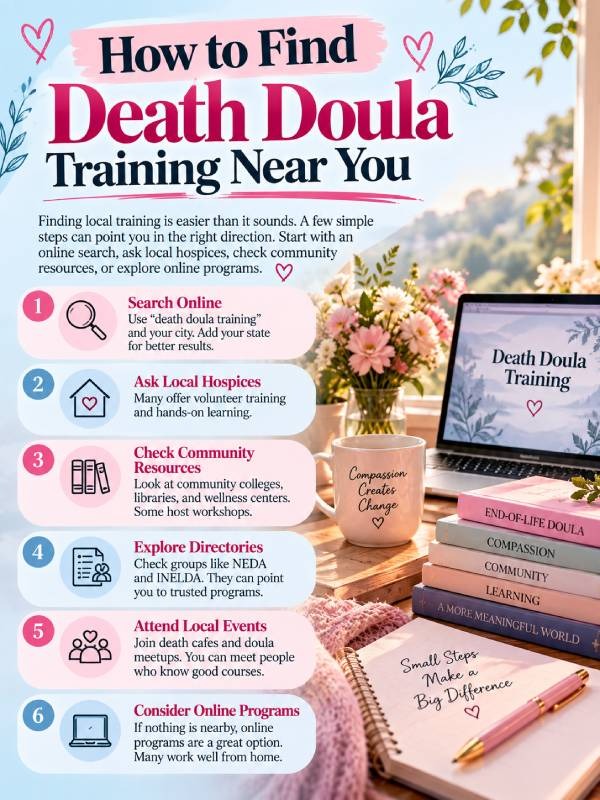
Finding local training is easier than it sounds. A few simple steps can point you in the right direction. Start with an online search that includes your city or state. Ask local hospices, since many offer volunteer training. Check community colleges, libraries, and wellness centers. If nothing is close, online programs are a good option.
- Search online with “death doula training” and your city. Add your state for better results.
- Ask local hospices about volunteer training. Many offer hands-on learning.
- Check community colleges, libraries, and wellness centers. Some host workshops.
- Look at directories from groups like NEDA and INELDA. They can point you to programs.
- Attend local death cafes and doula meetups. You can meet people who know good courses.
- Consider online programs if nothing is nearby. Many work well from home.
Frequently Asked Questions
What is a death doula?
A death doula is a non-medical guide who supports dying people and their families. They offer emotional, practical, and spiritual care.
Do I need a license to become a death doula?
No federal license is required in the United States. Certification is optional but can build trust.
How long does it take to become a death doula?
It depends on the program. Some take a few weeks, while others take months with practice hours.
Can I become a death doula without a medical background?
Yes. Compassion, listening skills, and good training matter most.
How much does death doula training cost?
Costs vary widely. Options range from free volunteer training to full paid certification programs.
Where can I find death doula training near me?
Search online with your city, ask local hospices, and check directories from groups like NEDA and INELDA.
Conclusion
Becoming a death doula starts with learning, caring, and taking small steps. Gain hands-on experience, choose a training program you trust, and join a professional group. Each step builds the skill and confidence you need.
This work is deeply meaningful, but it asks for heart and boundaries. Look after yourself as you care for others. When you are ready, begin with one step today.