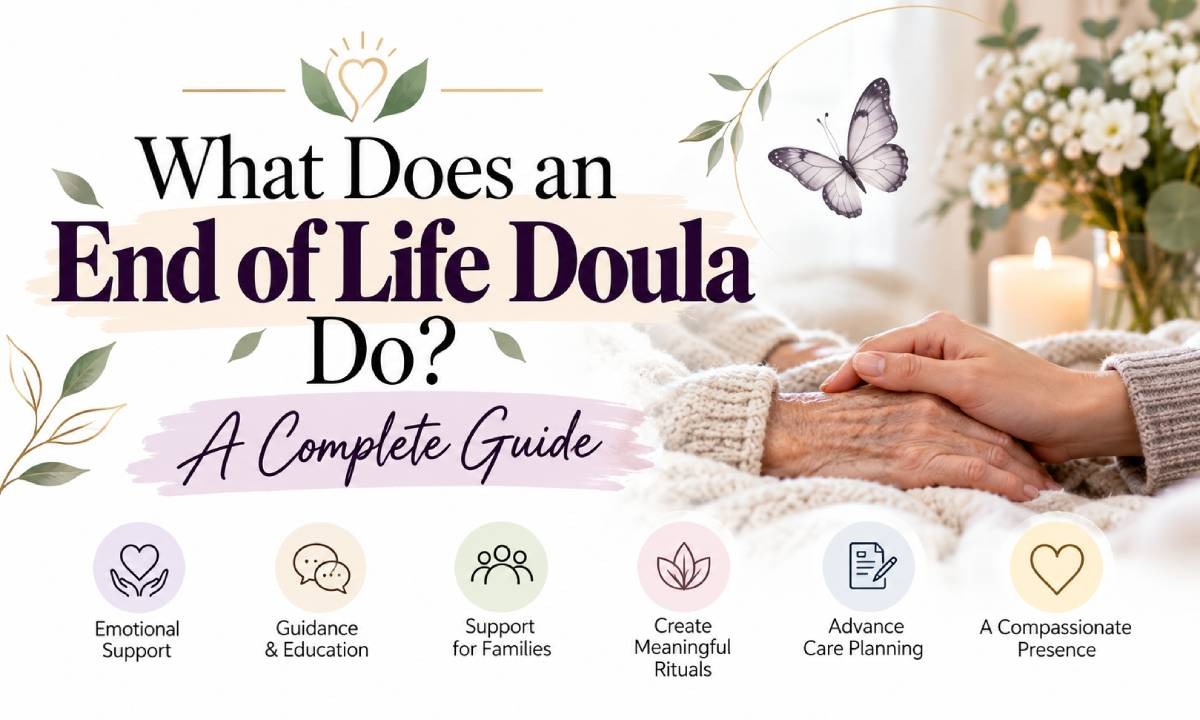
what does an end of life doula do ? An end-of-life doula provides compassionate, non-medical support to individuals and families throughout the end-of-life journey.Facing a terminal diagnosis, whether your own or a loved one’s, raises a lot of practical questions medicine alone doesn’t answer. An end of life doula exists to fill exactly that gap: steady, non-medical presence through one of life’s hardest passages. This guide covers what they actually do, how they work with hospice, what they cost, and how to find one.
What Is an End of Life Doula?
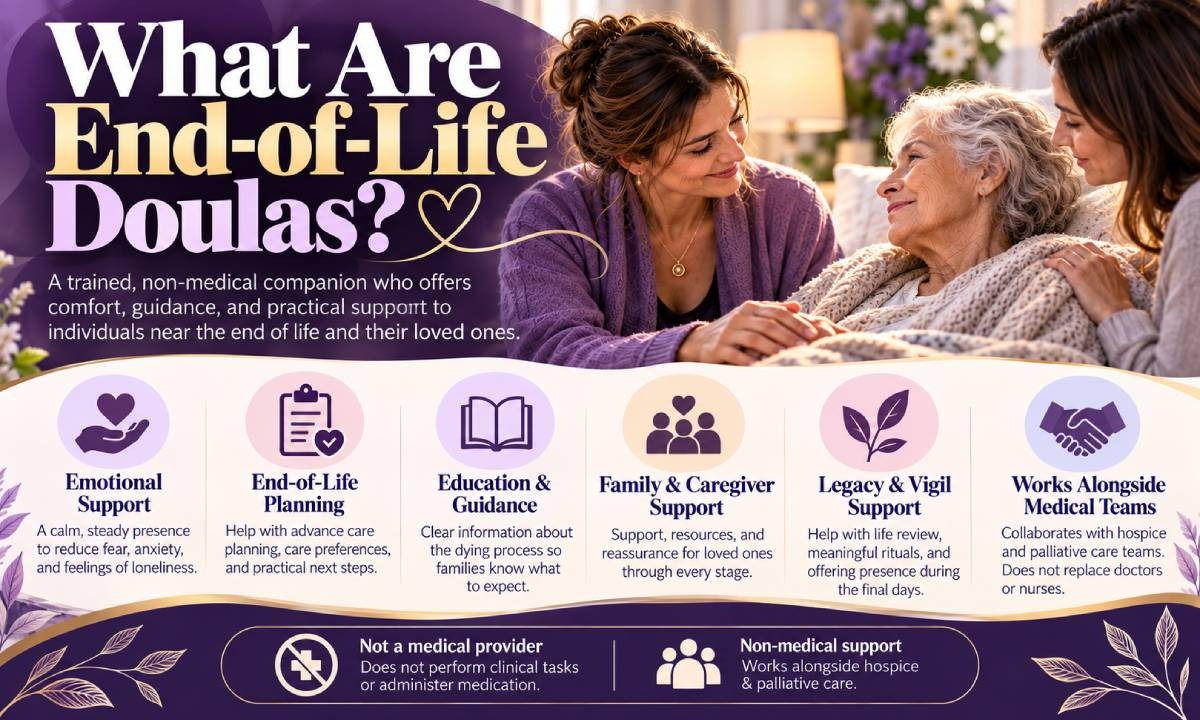
An end of life doula, also called a death doula or death midwife, is a trained, non-medical companion who supports a dying person and their family through emotional, practical, spiritual, and educational dimensions of the dying process. The role borrows its name and philosophy from birth doulas, offering presence and guidance rather than clinical care. Doulas typically become involved well before the final days, sometimes right after a diagnosis, and their involvement can continue through the vigil itself and into the family’s early grief. Unlike hospice staff, doulas aren’t bound by scheduled visits or insurance eligibility rules, which is exactly what lets them offer the kind of unhurried, flexible companionship a clinical system often can’t.
- An end of life doula offers non-medical emotional, practical, and spiritual support.
- The role is modeled on the birth doula approach to sustained presence.
- Involvement can begin right after diagnosis, not only near death.
- Support often continues through the vigil and into early grief.
- Doulas aren’t bound by hospice eligibility rules or fixed visit schedules.
- The role works alongside hospice and medical care, never replacing it.
What Does an End of Life Doula Do?
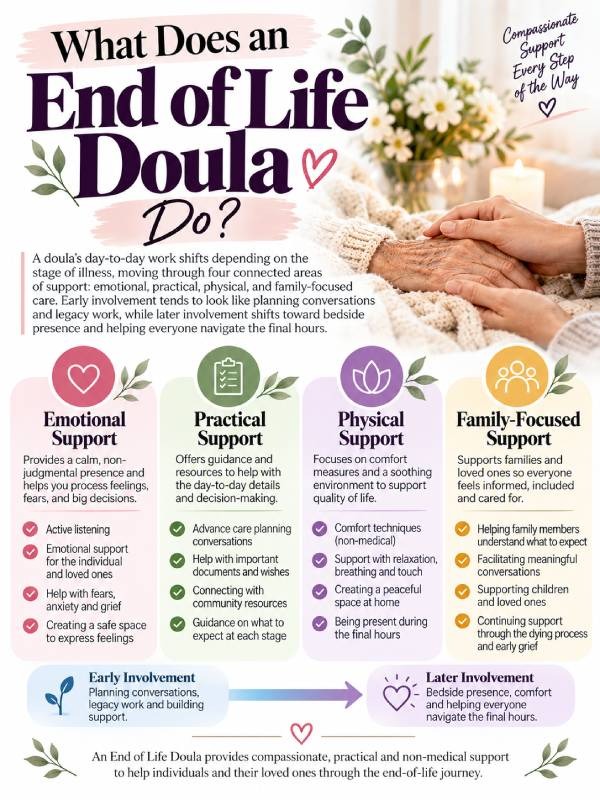
A doula’s day-to-day work shifts depending on the stage of illness, moving through four connected areas of support: emotional, practical, physical, and family-focused care. Early involvement tends to look like planning conversations and legacy work, while later involvement shifts toward bedside presence and helping everyone navigate the final hours. Below, each of these areas is broken down in more detail.
Emotional and Spiritual Support
Much of a doula’s work involves simply staying present with whatever emotion is in the room, fear, anger, grief, or even relief, without rushing to redirect or resolve it. This extends to spiritual or existential questions about meaning, legacy, and what comes next, held without imposing any particular belief system on the dying person or their family. Doulas are trained specifically not to reassure prematurely, since jumping straight to comfort often shuts down a conversation someone actually needed to have.
- Doulas stay present with difficult emotions rather than redirecting them.
- Spiritual support is offered without requiring a shared belief system.
- Doulas avoid premature reassurance that can shut down honest conversation.
- This support includes helping someone process anticipatory grief.
- Humor and silence are both treated as valid parts of this process.
- The goal is companionship with hard feelings, not resolution of them.
📖 Read More
Learn more about this topic by visiting what does an end of life doula do ↗ .
Practical and Legacy Planning Support
Doulas help families think through and document what the dying person actually wants, including where they’d like to be when they die, who they want present, and what matters most to them in their final days. This often extends into legacy work, recorded stories, letters for future milestones, memory boxes, or an ethical will passing down values rather than possessions. These conversations, started early and unhurried, tend to reduce the kind of rushed, crisis-driven decisions families often regret later.
- Doulas help document end-of-life preferences well before a crisis hits.
- Legacy projects like recorded stories and letters are common offerings.
- Ethical wills pass down values and lessons, not just possessions.
- Early planning reduces rushed decisions made during a medical crisis.
- This work gives the dying person real agency over their own process.
- Legacy work can be spread across several sessions, not rushed.
Physical Comfort and Presence
During the final hours or days, a doula can sit vigil, helping the family recognize what’s physically normal during active dying and adjusting the room’s lighting, music, or atmosphere to feel calmer. This isn’t clinical care, doulas don’t administer medication or treat symptoms, but their presence reduces the family’s cognitive load during an overwhelming time. Many doulas remain for extended stretches, including overnight, which is one of the most distinctive advantages they offer over a scheduled clinical visit.
- Doulas sit vigil and help families recognize normal signs of active dying.
- They can adjust the room’s environment to feel calmer and more comfortable.
- This presence is non-clinical and never includes administering medication.
- Extended, even overnight, availability is a distinctive doula advantage.
- Doulas help reduce family anxiety by explaining physical changes calmly.
- Their steady presence allows family members to rest in shifts.
Support for Family and Caregivers
A doula’s care extends well beyond the dying person to the family and caregivers surrounding them, offering respite, emotional support, and sometimes practical help like errands or coordinating visitor schedules. After death, many doulas stay involved through the immediate aftermath, helping with initial calls and logistics, and some remain available during early grief. Ongoing grief counseling, however, is typically handed off to a licensed bereavement specialist, since that falls outside a doula’s trained, non-clinical scope.
- Doulas offer respite and emotional support directly to exhausted caregivers.
- Practical help can include errands or coordinating visitor schedules.
- Support often continues through the immediate aftermath of death.
- Some doulas remain available informally during early grief.
- Ongoing grief counseling is referred to a licensed bereavement specialist.
- This handoff reflects the limits of a doula’s trained, non-clinical scope.
What an End of Life Doula Does Not Do
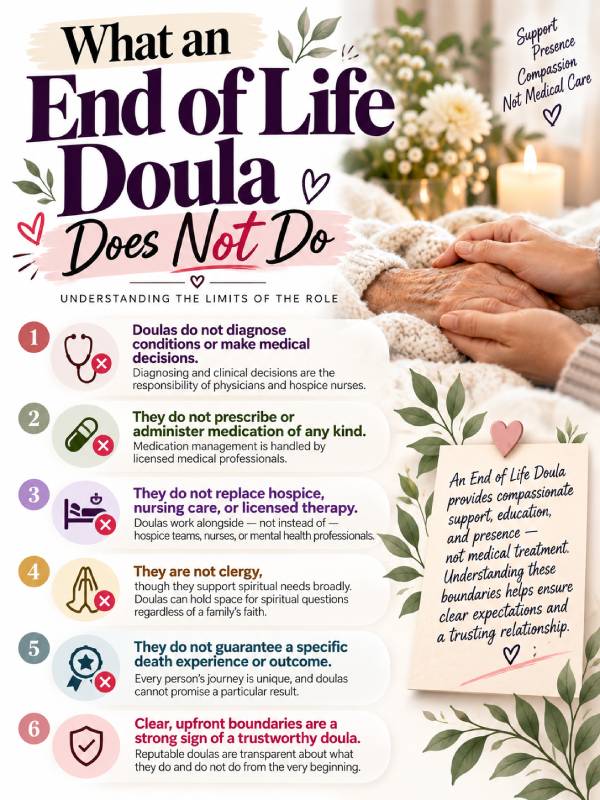
To keep expectations accurate, it helps to be explicit about the role’s limits. A doula does not diagnose medical conditions, prescribe or administer medication, or make clinical decisions, all of which remain squarely within the scope of physicians and hospice nurses. They don’t replace hospice or nursing care, provide licensed mental health treatment, or act as clergy, though they can hold space for spiritual questions regardless of a family’s faith. Reputable doulas are explicit about these boundaries from the start, since a clearly defined non-medical scope is one of the clearest signs of a trustworthy practitioner.
- Doulas do not diagnose conditions or make medical decisions.
- They do not prescribe or administer medication of any kind.
- They do not replace hospice, nursing care, or licensed therapy.
- They are not clergy, though they support spiritual needs broadly.
- They do not guarantee a specific death experience or outcome.
- Clear, upfront boundaries are a strong sign of a trustworthy doula.
How Does an End of Life Doula Work with Hospice?
Hospice and palliative teams are clinical by design, managing medication, symptoms, and benefits within scheduled visits and large caseloads. A doula sits distinctly outside that clinical structure, adding time and continuity, hours of unhurried presence rather than a fifteen-minute check-in, that the hospice system often can’t provide on its own. The two roles are meant to complement each other: doulas defer to clinical judgment on anything medical, keep the rest of the care team informed of major changes they observe, and some hospice organizations now formally employ or partner with doulas directly as part of their own staff.
- Hospice manages clinical care; doulas add unhurried, non-medical presence.
- Doulas defer entirely to clinical judgment on medical matters.
- Good doulas keep the hospice team informed of changes they observe.
- Some hospice organizations now formally employ or partner with doulas.
- The two roles are designed to work in tandem, not in competition.
- Families often benefit most when both roles communicate regularly.
When Should You Bring in an End of Life Doula?
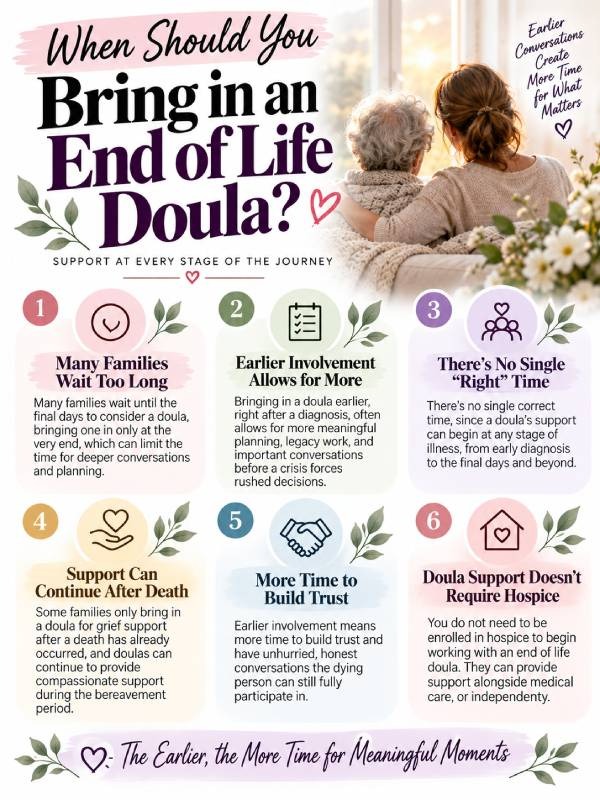
Many families wait until the final days to consider a doula, but earlier involvement, right after a diagnosis, often allows for more meaningful planning and legacy work before a crisis forces rushed decisions. There’s no single “right” time, since a doula’s support can begin at any stage and some families only bring one in for grief support after a death has already occurred. The earlier a doula is involved, the more time there is to build trust and have unhurried, honest conversations the dying person can still fully participate in.
- Many families wait too long, bringing a doula in only at the very end.
- Earlier involvement allows for more meaningful planning and legacy work.
- There’s no single correct time; doulas support every stage of illness.
- Some families only engage a doula for grief support after death.
- Earlier involvement means more time to build trust before a crisis.
- Doula support doesn’t require hospice enrollment to begin.
What Does It Cost to Hire an End of Life Doula?
Because almost every doula works as an independent contractor, pricing varies by region, experience, and how services are structured rather than following a fixed national rate. Hourly pricing commonly falls between about $25 and $125, while many doulas instead offer package pricing bundling planning, vigil support, and follow-up into one fee, often ranging from roughly $500 to $3,500 or more. Some doulas use sliding-scale or donation-based pricing specifically to keep their services accessible to families with limited financial resources, and it’s always worth asking a specific doula directly how they price their work.
- Hourly rates commonly range from about $25 to $125.
- Package pricing often runs from $500 to $3,500 or more per client.
- Sliding-scale and donation-based pricing are common in this field.
- Pricing varies significantly by region and a doula’s experience level.
- No standardized national fee schedule currently exists for this work.
- Always confirm pricing structure directly before committing to hire someone.
How to Find an End of Life Doula Near You
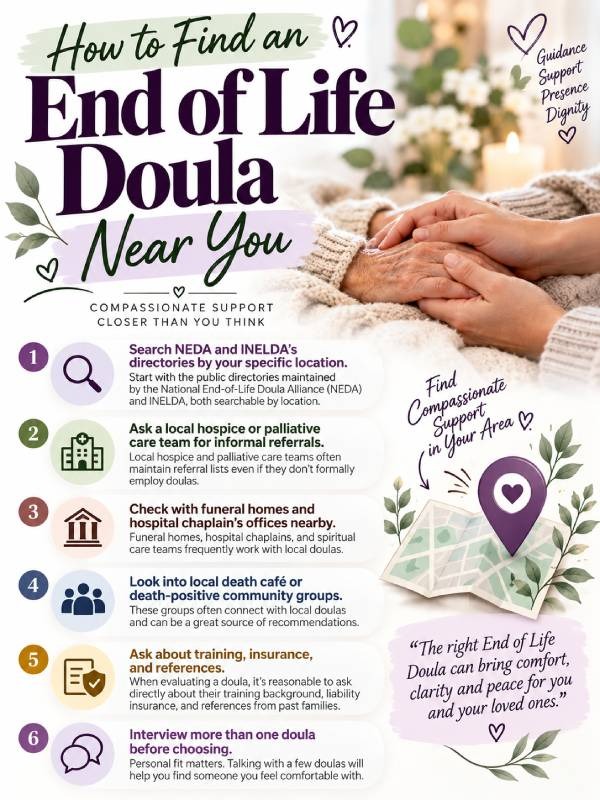
Start with the public directories maintained by the National End-of-Life Doula Alliance (NEDA) and INELDA, both searchable by location for trained practitioners. Local hospice and palliative care teams often maintain informal referral lists even without formally employing doulas, so a direct call is worth trying. Funeral homes, hospital chaplains, and local death café groups frequently cross paths with local doulas as well, and when evaluating someone you find, it’s reasonable to ask directly about their training background, liability insurance, and references from past families.
- Search NEDA and INELDA’s directories by your specific location.
- Ask a local hospice or palliative care team for informal referrals.
- Check with funeral homes and hospital chaplain’s offices nearby.
- Look into local death café or death-positive community groups.
- Ask directly about training, insurance, and past client references.
- Interview more than one doula before choosing, since personal fit matters.
Frequently Asked Questions
What does an end of life doula do exactly?
An end of life doula provides non-medical emotional, practical, spiritual, and educational support to a dying person and their family, from early planning conversations through the vigil itself and into early grief.
Is an end of life doula the same as hospice?
No, hospice is a clinical medical benefit managing symptoms and medication, while a doula is a non-medical companion offering unhurried presence and planning support alongside hospice care.
Can an end of life doula give medication or medical care?
No, doulas do not diagnose, prescribe, or administer medication; all clinical care remains the responsibility of physicians and hospice nursing staff.
How early should you contact an end of life doula?
Many families benefit from reaching out right after a diagnosis, since earlier involvement allows more time for meaningful planning conversations and legacy work before a crisis.
Does insurance or Medicare cover end of life doula services?
No, end of life doula services are almost always private-pay, since the role isn’t recognized as a covered medical benefit by insurance or Medicare.
Conclusion
An end of life doula’s work comes down to one central purpose: making sure no one faces dying, or supports someone through it, entirely alone. Whether you’re exploring this kind of support for yourself, a loved one, or simply trying to understand how it fits alongside hospice, the path forward starts with the same questions this guide has answered — what they do, when to bring them in, and how to find the right one for your situation.