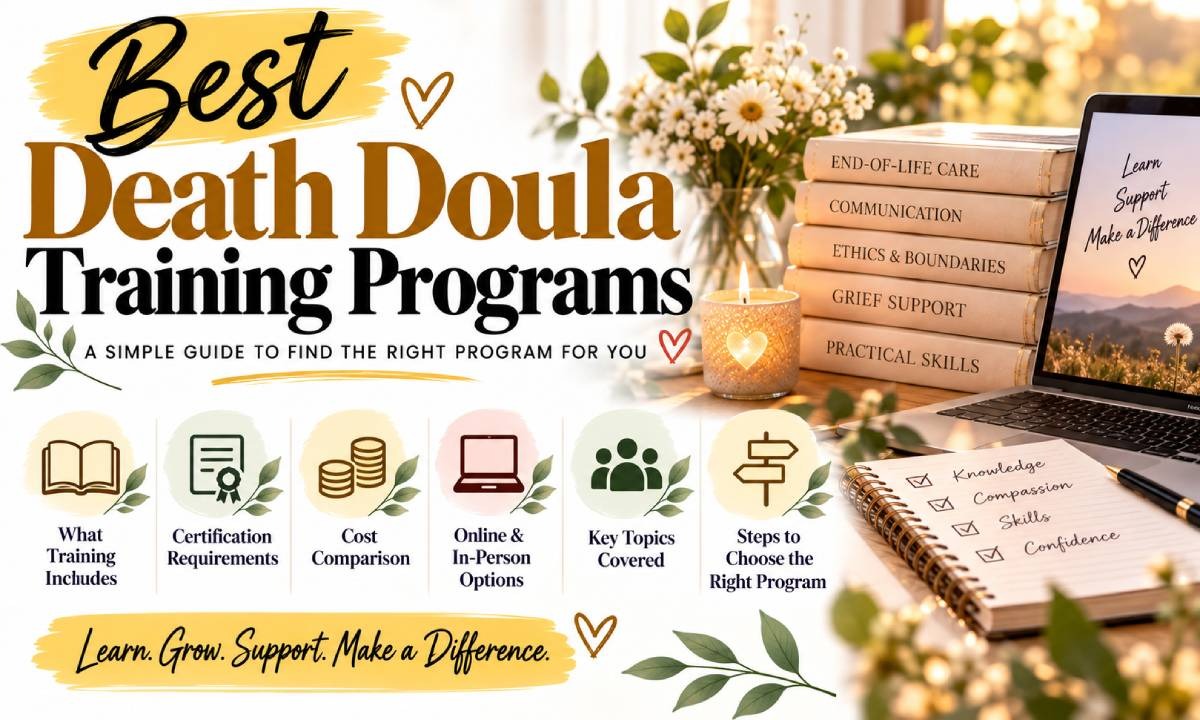
Death doulas come to this work from very different directions, and some of the most compelling stories begin with a personal encounter with loss rather than a career plan. This guide looks at what a path into the work can look like, using Ocean Phillips, an INELDA-trained doula and humanist chaplain, as one example. It also covers the wider “good death” movement, the role of training organizations like Doulagivers Institute, and practical steps for finding training online or nearby.
A note on sources: Ocean Phillips’ background below comes from the doula’s profile published by INELDA, and Doulagivers Institute’s details come from its founder’s published book descriptions and podcast pages. Where program specifics like pricing, curriculum, or event dates aren’t publicly confirmed in those sources, this guide points you to the organization directly rather than guessing.
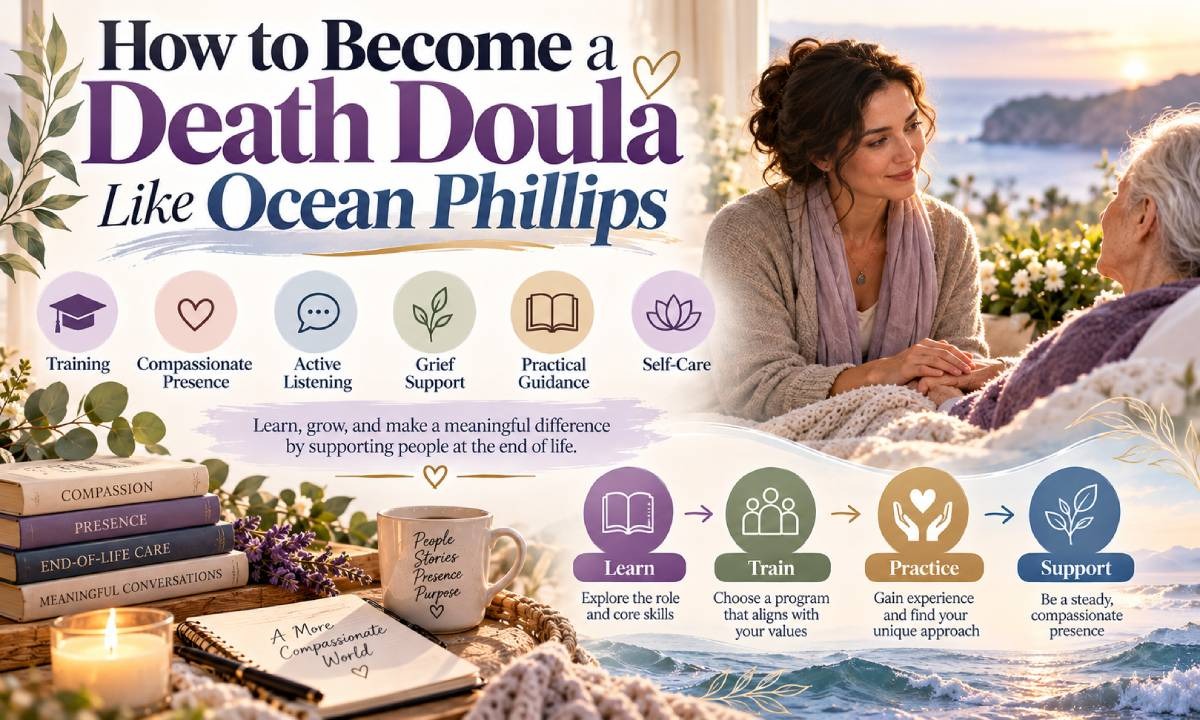
How to become a death doula like Ocean Phillips
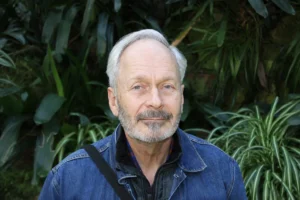
Ocean Phillips (they/them) is an INELDA-trained doula who also serves as a humanist chaplain, and their path into death work was shaped by personal experience rather than a conventional healthcare career. According to INELDA’s profile, Ocean was present in Thailand during the 2004 tsunami, an experience that led directly to some of their earliest encounters with death work, and a shared death experience with their mother roughly twenty years ago deepened their sense that death is a spiritual passage rather than only a medical event. Their approach centers on spiritual care in whatever form fits the client, including exploring what spirituality means to a person, “if anything,” which reflects the broader doula principle of following the dying person’s own beliefs rather than imposing one. For anyone hoping to follow a similar path, the takeaway isn’t to replicate this exact story, but to notice that most doulas begin with a personal reckoning around death and then formalize that calling through recognized training.
- Ocean Phillips is an INELDA-trained doula and humanist chaplain.
- Their path into death work began through personal, spiritual experiences.
- Spiritual care for them means following the client’s own beliefs, if any.
- Formal training, here through INELDA, turned a calling into a practice.
- Many doulas begin with a personal encounter with loss or mortality.
- Your own path doesn’t need to mirror theirs, only be genuine and trained.
The Good Death Movement
The “good death” movement is a broader cultural push to make dying less isolating, less medicalized, and more intentional, giving people and families more say in how the end of life unfolds. Doulagivers Institute, founded in 2012 by hospice and oncology nurse Suzanne O’Brien, has made this idea central to its mission, which is to provide affordable, accessible education so more people can die with comfort and dignity at home. O’Brien’s 2025 book, The Good Death, distills her decades in healthcare into a step-by-step guide for preparing for the death of a loved one, covering financial, physical, mental, emotional, and spiritual preparation. The institute has described a goal of training one million people worldwide as death doulas, which gives a sense of how ambitious this movement sees itself as being.
- The good death movement aims to make dying less isolating and medicalized.
- Doulagivers Institute was founded in 2012 by hospice nurse Suzanne O’Brien.
- Its stated mission is accessible education so more people can die at home.
- O’Brien’s book The Good Death was published in 2025 as a family guide.
- The institute has publicly stated a goal of training one million doulas.
- The movement sits within the broader “death positive” cultural shift.
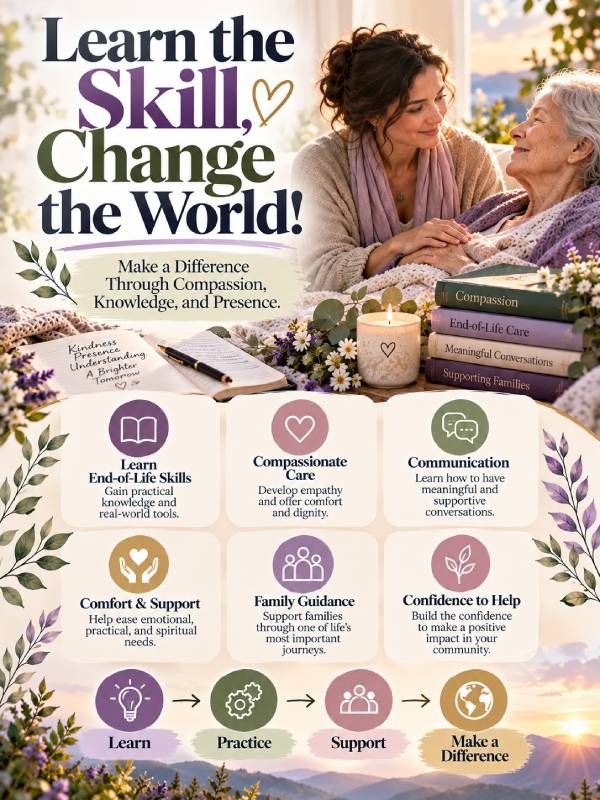
Learn the Skill, Change the World!
The idea behind this slogan is straightforward: supporting someone through dying is a learnable skill, not a mystical gift reserved for a few, and more trained companions means fewer people facing the end of life alone. The core skills are teachable, including sitting calmly with fear, explaining the physical signs of dying in plain language, having honest planning conversations, and offering respite to exhausted caregivers. Learning these skills often changes the learner as much as the people they later serve, since most doulas describe the work reshaping their own relationship with mortality. The “change the world” part is less about grand gestures and more about the cumulative effect of many families being better supported at a time that otherwise tends to be frightening and chaotic.
- Supporting the dying is a learnable skill, not a rare innate gift.
- Core skills include listening, explaining dying, and planning conversations.
- Learning these skills often changes the learner’s own view of mortality.
- More trained companions mean fewer people facing death alone.
- Impact comes from many small, well-supported family experiences.
- Anyone can begin learning, regardless of prior healthcare background.
Empowering Caregivers. Transforming End-of-Life Care.
Much of end-of-life caregiving falls on family members who have no training and little guidance, learning on the fly during one of the most stressful periods of their lives. Programs built around the doula model aim to change that by teaching ordinary caregivers practical skills so they feel confident rather than overwhelmed. Doulagivers’ own framing is that empowering caregivers is itself a way of transforming end-of-life care, since the vast majority of care happens at home, outside clinical settings, and depends on the people closest to the dying person. When caregivers feel prepared, families tend to report less fear, fewer rushed decisions, and more meaningful time together in the final weeks.
- Most end-of-life caregiving falls on untrained family members.
- Doula-style training gives caregivers practical, confidence-building skills.
- Most dying happens at home, supported mainly by loved ones.
- Prepared caregivers tend to experience less fear and fewer rushed decisions.
- Empowering caregivers is framed as a way of transforming care itself.
- This approach complements, rather than replaces, hospice and medical teams.
Why We Need Non-Medical End of Life Care Practitioners Now More Than Ever
Hospice and palliative teams provide essential clinical care, but they work within tight caseloads, scheduled visits, and benefit structures that leave real gaps in sustained, unhurried human presence. At the same time, populations are aging in many countries, more families are navigating prolonged caregiving, and public conversation around dying has opened up, which together increase demand for support that clinical systems alone can’t provide. Non-medical practitioners like doulas fill part of that gap by offering time, continuity, and companionship at a lower barrier than most clinical services, often starting well before hospice eligibility begins. Because the need is growing faster than formal systems can respond, trained community-level practitioners are increasingly seen as a practical complement to the existing care infrastructure.
- Clinical teams face tight caseloads and scheduled visit limits.
- Aging populations are increasing demand for end-of-life support.
- Non-medical practitioners add sustained, unhurried human presence.
- Doula support can begin well before hospice eligibility starts.
- Need is growing faster than formal care systems can respond alone.
- Trained community practitioners complement, not replace, clinical care.
Doulagivers are “Filling the Gap” in Mainstream Medical End of Life Care!
The “gap” in mainstream end-of-life care isn’t a failure of any one provider; it’s a structural reality that medicine is built to manage symptoms and prognosis, not to sit with fear, hold space for meaning, or help a family plan a vigil. Doulagivers’ model, as described by its founder, grew out of her own experience as a hospice nurse seeing the financial and staffing limits of hospice care firsthand and wanting families to have more tools than the system alone could supply. Its approach teaches the broader public, not only professionals, how to provide comfort, companionship, and practical support, with the care model now practiced in more than twenty countries according to the founder’s publisher. Whether through formal doula work or informed caregiving by family, the idea is the same: more trained, compassionate presence at the bedside fills a role clinical teams were never staffed to cover.
- The gap is structural, not a failure of individual clinicians.
- Medicine is built for symptom management, not sustained companionship.
- Doulagivers grew from its founder’s hospice nursing experience.
- Its model teaches both professionals and the general public.
- The publisher states the model is practiced in over twenty countries.
- Informed family caregiving and doula work serve the same underlying gap.
What is a Death Doula?
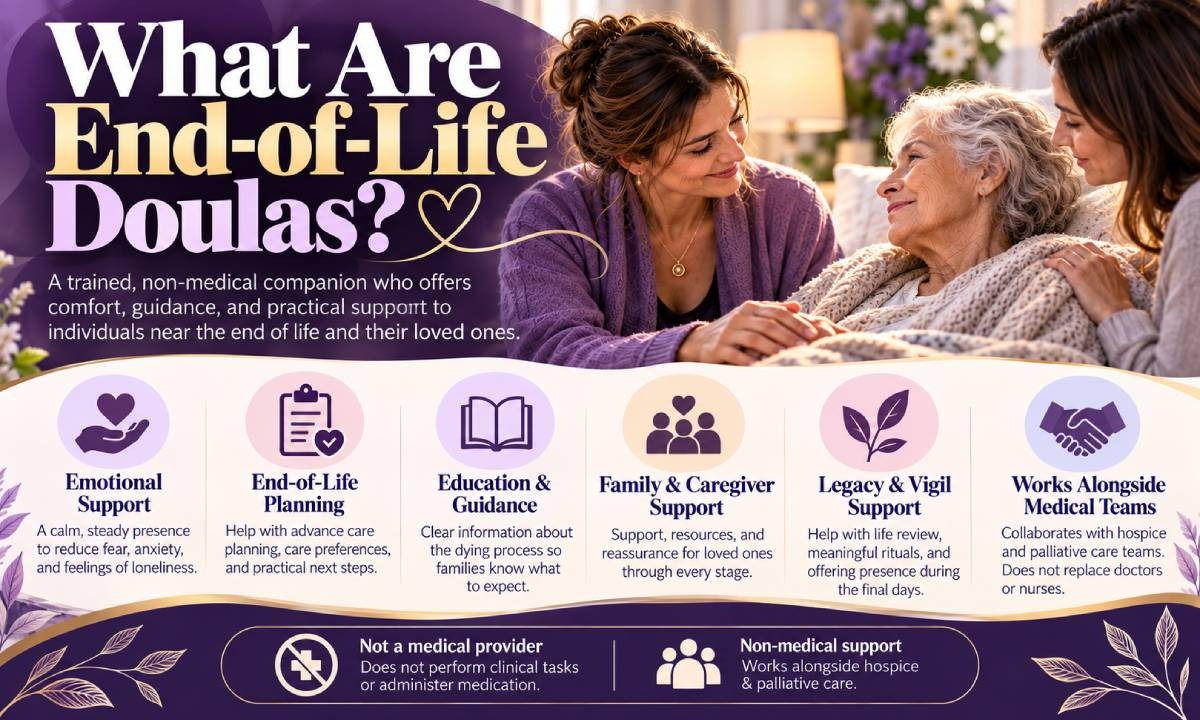
A death doula, also called an end-of-life doula or death midwife, is a trained, non-medical companion who supports a dying person and their family through emotional, practical, spiritual, and educational dimensions of the dying process. The role borrows its name and philosophy from birth doulas, offering presence and guidance rather than clinical care. Doulas typically become involved well before the final days, sometimes right after a diagnosis, and their involvement can continue through the vigil and into early grief. They work alongside hospice and medical teams, never replacing them, and they stay strictly within a non-medical scope, meaning no diagnosing, prescribing, or clinical decision-making.
- A death doula offers non-medical emotional, practical, and spiritual support.
- The role is modeled on the birth doula approach to presence.
- Involvement can start right after diagnosis, not just near death.
- Support often continues through the vigil and into early grief.
- Doulas work alongside hospice, never replacing clinical care.
- Their scope is strictly non-medical by definition.
Become a Death Doula
Becoming a death doula starts with training from a recognized program, such as INELDA, the National End-of-Life Doula Alliance, a university-affiliated certificate, or an organization like Doulagivers Institute. No state or federal license is required to practice, so quality varies, which makes choosing a program with a clear curriculum, a published ethics code, and some form of supervised or practical experience especially important. After training, most doulas build their practice gradually through direct client experience, referrals from local hospices and chaplains, and community presence. Many begin part-time or volunteering while building confidence and a reputation, since sustainable income from this work typically takes years to develop.
- Start with a recognized training program in the field.
- No license is legally required, so program quality varies widely.
- Look for a clear curriculum and a published code of ethics.
- Build direct client experience, often starting through volunteering.
- Network with local hospices, chaplains, and funeral homes for referrals.
- Expect income to build gradually rather than immediately.
Doulagivers Specialist Program
Doulagivers Institute offers a training program under its own branding, positioned as accessible, practical education for people who want to support the dying, whether professionally or as family caregivers. Because specific details such as curriculum length, cost, certification outcomes, and format can change, the most reliable step is to review the program directly on the institute’s website rather than relying on third-party summaries. When evaluating any specialist program, including this one, it’s worth asking what practical, hands-on components it includes, how it addresses scope of practice and ethics, and what ongoing support or community it offers graduates. Comparing it against other recognized options, like INELDA or university-affiliated certificates, can help you decide which fits your goals and budget.
- Doulagivers Institute offers its own branded training program.
- Confirm current curriculum, cost, and format directly with the institute.
- Ask what hands-on, practical components the program includes.
- Check how the program addresses scope of practice and ethics.
- Ask what community or ongoing support graduates receive.
- Compare it against other recognized programs before enrolling.
Ask A Death Doula Podcast
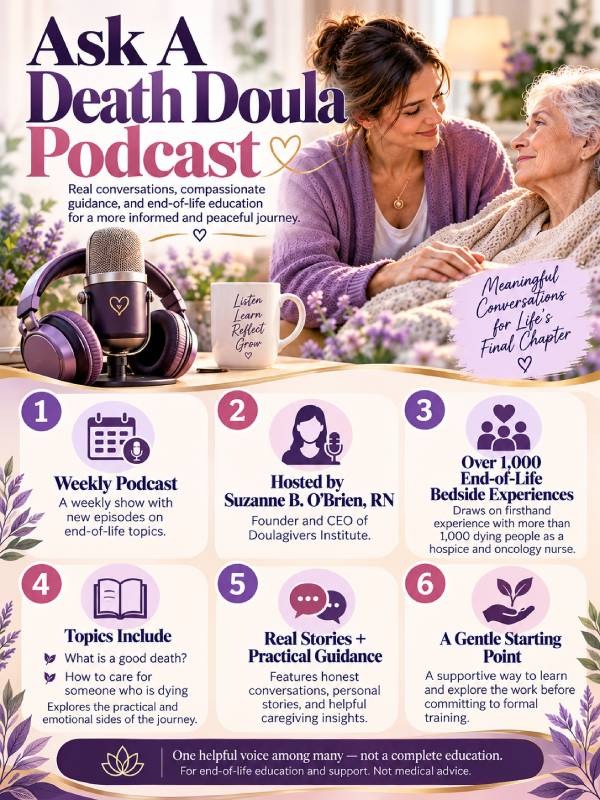
The Ask A Death Doula podcast is a weekly show hosted by Suzanne O’Brien, the founder of Doulagivers Institute, drawing on her experience as a hospice and oncology nurse and her work at the bedside with more than a thousand dying people, as described on the show’s page. Episodes cover topics like what constitutes a “good death,” how to care for someone who is dying, and the practical and emotional dimensions of the process that families often find frightening. For anyone considering this work, a podcast like this can be a gentle entry point: it lets you hear real stories and practical guidance before deciding whether formal training is right for you. As with any single source, it’s best treated as one voice among several rather than a complete education.
- The podcast is a weekly show hosted by Doulagivers’ founder.
- It draws on bedside experience with over a thousand dying people.
- Episodes cover what a “good death” means and how to provide care.
- Audio can be a gentle entry point before committing to training.
- It offers real stories alongside practical caregiving guidance.
- Treat it as one voice among several, not a complete education.
The Good Death Book – Now Available For Order!
The Good Death: A Guide for Supporting Your Loved One through the End of Life, by Suzanne O’Brien, is a 272-page book published by Vermilion in 2025. Its publisher describes it as a step-by-step guide to preparing for the future death of someone close to you and helping them through the passing itself, covering financial, physical, mental, emotional, and spiritual preparation. The book is aimed at families and caregivers rather than only professional doulas, which makes it a practical starting point for anyone in the early stages of caring for someone who is dying. It’s available through major booksellers and libraries, and checking your local library can be a low-cost way to read it first.
- The Good Death is a 272-page book published by Vermilion in 2025.
- It offers a step-by-step guide for supporting a dying loved one.
- It covers financial, physical, mental, emotional, and spiritual preparation.
- It’s written for families and caregivers, not only professionals.
- It’s available through major booksellers and many libraries.
- Reading it can help you decide whether doula training appeals to you.
Free Good Death Seminar Series
Free educational events, like seminar series on the good death, are a common way for end-of-life organizations to introduce the public to topics many people avoid until a crisis forces them. These sessions typically cover basics such as advance planning, what to expect as dying progresses, and how to talk with family about wishes, often taking place online so people anywhere can attend. Because schedules, topics, and registration details change, the reliable way to find current sessions is through the organization’s own website or newsletter rather than third-party listings. Attending a free session first is a low-risk way to test whether this subject feels meaningful to you before investing in formal training.
- Free seminars introduce the public to difficult but important topics.
- Typical topics include advance planning and what to expect in dying.
- Many sessions run online, so location rarely limits attendance.
- Check the organization’s own site for current dates and registration.
- Free sessions are a low-risk way to test your interest in this work.
- They can also help families begin conversations they’ve been avoiding.
Sign up for our weekly Newsletter for Empowerment, Healing and Inspiration
A newsletter can be a steady, low-pressure way to keep learning about end-of-life care without committing to a course, delivering short reflections, practical tips, and updates on upcoming events directly to your inbox. For people curious about death doula work, subscribing to a few reputable sources, whether from a training organization, a professional alliance, or an individual doula, builds familiarity with the field’s language and current conversations. It’s reasonable to review any newsletter’s sender and privacy practices before signing up, as with any subscription. Treat newsletters as a supplement to proper training and trusted guidance, not a replacement for either.
- Newsletters offer steady, low-pressure learning about end-of-life topics.
- They typically include reflections, tips, and event announcements.
- Subscribing to a few reputable sources builds familiarity with the field.
- Review a sender’s privacy practices before subscribing.
- Newsletters can help you follow current conversations in the movement.
- They supplement proper training and don’t replace it.
Find awesome listings near you!
Directory listings help connect families with local doulas and help doulas be found, and the most established ones are maintained by the National End-of-Life Doula Alliance and INELDA, both searchable by location. Many hospices and palliative care teams also keep informal referral lists, and community groups such as death cafés often know practicing doulas in the area. When using any listing, it’s worth confirming a doula’s training background, how they coordinate with medical teams, and whether they can provide references from past families rather than relying on the listing alone. A good listing is a starting point for conversation, not a guarantee of quality.
- NEDA and INELDA maintain searchable directories by location.
- Local hospice teams often keep informal referral lists.
- Death cafés and community groups often know local practitioners.
- Confirm training, insurance, and coordination with medical teams.
- Ask for references from past families before committing.
- Treat a listing as a starting point, not proof of quality.
How to become a death doula online
Online training has made this work far more accessible, since many programs now run fully virtual or hybrid courses that let learners study from anywhere without relocating. Recognized options include INELDA’s trainings, which are offered both online and in person, university-affiliated certificates, and Doulagivers Institute’s own online education. When choosing an online program, look for a clear curriculum, instructor experience, a published code of ethics, and some route to practical experience, since reading and lectures alone can’t fully replace time spent with real clients. It also helps to ask how the program supports graduates afterward, through community, mentorship, or referral connections, because building a practice is a separate task from completing a course.
- Many programs now run fully virtual or hybrid, so location rarely limits you.
- INELDA, university certificates, and Doulagivers all offer online options.
- Look for a clear curriculum and a published code of ethics.
- Ask how the program provides practical, client-facing experience.
- Check what mentorship or community support exists after graduation.
- Remember that completing a course and building a practice are separate steps.
📖 Read More
Learn more about this topic by visiting how to become a death doula ↗ .
How to become a death doula near me
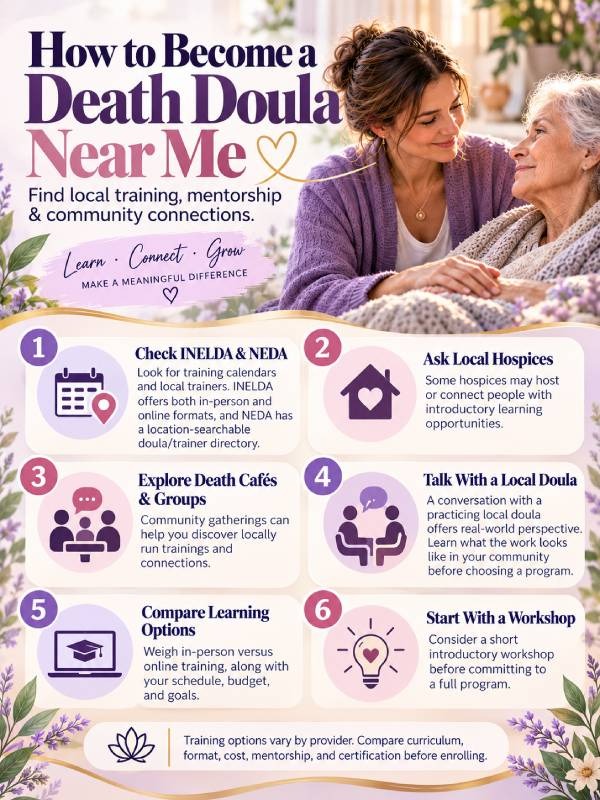
Finding in-person training or mentorship nearby starts with checking the training calendars of INELDA and the National End-of-Life Doula Alliance, since both run sessions in multiple cities alongside virtual options. Local hospice organizations sometimes host or co-sponsor introductory workshops, which can be a lower-commitment way to explore the work. Death café groups and other death-positive community gatherings often know about smaller, locally run trainings that don’t appear in national directories. Connecting with a practicing doula in your area, even for an informal conversation, can also help you understand how the work looks in your specific community before you commit to any program.
- Check INELDA and NEDA’s training calendars for sessions near you.
- Local hospices sometimes host introductory workshops.
- Death cafés and community groups often know small local trainings.
- A conversation with a practicing local doula offers real-world perspective.
- Compare in-person and online options against your schedule and budget.
- Consider a short workshop first before committing to a full program.
Frequently Asked Questions
Who is Ocean Phillips?
Ocean Phillips (they/them) is an INELDA-trained death doula and humanist chaplain whose work emphasizes spiritual care for the dying in whatever form fits each client, according to INELDA’s published profile.
What is the Good Death movement?
It’s a broader cultural effort to make dying less isolating and medicalized, giving people and families more say in how the end of life unfolds, with organizations like Doulagivers Institute promoting accessible education toward that goal.
Who founded Doulagivers Institute?
Suzanne O’Brien, a hospice and oncology nurse, founded Doulagivers Institute in 2012 and later wrote The Good Death, published in 2025.
Do I need a license to become a death doula?
No, no state or federal license is currently required, though many reputable doulas complete training through recognized programs to build skill and credibility.
Can I become a death doula online?
Yes, many recognized programs, including INELDA and Doulagivers Institute, offer online or hybrid training, though practical, client-facing experience remains an important part of building a practice.
How do I find death doula training near me?
Check INELDA and NEDA’s training calendars, ask local hospice teams about workshops, and look into local death café or death-positive community groups.
Conclusion
Becoming a death doula often starts with a personal encounter with loss, as Ocean Phillips’ story illustrates, and then grows through recognized training, practical experience, and community connection. Whether you pursue training online or near home, through INELDA, a university program, or an organization like Doulagivers Institute, the common thread is the same: a willingness to sit with dying and help families face it with less fear and more support. If this work calls to you, begin with one small step, a book, a free seminar, or a conversation with a local doula, and let the path unfold from there.